
ADU Rules in Bend vs. Rural Deschutes County: What You Can Build

ADU Rules in Bend vs. Rural Deschutes County: What You Can Build
ADU Rules in Bend vs. Rural Deschutes County: What You Can Build
Select Design & Build Published: October 28, 2026
Yes, you can build an accessory dwelling unit (ADU) on many lots in and around Bend, but the rules depend on which side of the city limits you’re on. Inside Bend, ADUs are allowed on most residential lots, up to 800 square feet, and a lot can have up to two. In rural Deschutes County, ADUs are allowed only in rural residential zones, on parcels of at least two acres (five in parts of South County), up to 900 square feet of usable floor area and within 100 feet of the main house. Here’s how each set of rules works, and what they mean for the ADU you have in mind.
First, confirm your jurisdiction and zone
ADU rules follow jurisdiction, so start by looking up the parcel in Deschutes County’s DIAL tool to see whether it’s inside Bend city limits and how it’s zoned. A Bend mailing address doesn’t mean the lot is in the city. Redmond, Sisters, and La Pine each set their own ADU rules, so if your land is in one of those cities, check with that planning department.
ADU rules inside Bend city limits
The City of Bend has been loosening ADU rules for close to a decade, and its ADU resource hub lays out the current basics:
-
Where they’re allowed: on residential (and some commercial) lots that have a single-unit home, a townhome, or a manufactured home.
-
Size: ADUs must be 800 square feet or less.
-
How many: up to two ADUs on a qualifying lot. The Bend Development Code limits a second ADU to 500 square feet.
-
Attached or detached: either works.
-
Parking: no minimum on-site parking is required.
-
One permit: a single application covers both the Planning and Building Safety review.
-
Zone standards still apply: floor area ratio, lot coverage, and setbacks follow your zoning district. The city’s ADU code requirements page notes special rules for NorthWest Crossing and historic areas.
A few practical points for city lots:
-
Utilities. Water and sewer service for the ADU has to meet Oregon code, so confirm capacity and connection routes with your water provider (City of Bend, Avion, or Roats) early.
-
Fees. City system development charges can apply to ADUs. Check the current schedule before you budget.
-
CC&Rs. Even where the city allows an ADU, your subdivision’s covenants or HOA design review may add limits. Read them first.
ADU rules in rural Deschutes County
Rural ADUs are newer. Deschutes County began accepting rural ADU applications on December 1, 2023, under state law (SB 391 and SB 644) and local code. The rules are tighter than in the city, and the county’s ADU page notes that it can’t grant variances from the requirements set in state statute.
Where rural ADUs are allowed
-
Only in rural residential zones: RR-10, MUA-10, UAR-10, SR 2½, and WTZ.
-
Not in resource zones such as Exclusive Farm Use, Forest (F1, F2), or Open Space and Conservation.
-
Not in urban reserve areas.
-
The parcel must already have one single-family dwelling and must be a legal lot of record.
Lot size
-
At least two acres in most of the county.
-
At least five acres in parts of Southern Deschutes County.
Size and placement
-
No more than 900 square feet of usable floor area. Attached garages, decks, and covered porches don’t count toward that limit.
-
The ADU must sit within 100 feet of the main house.
Services
-
The parcel must be served by a fire protection district.
-
Wastewater: an approved ADU septic site evaluation, or a “will serve” letter from a sewer district.
-
Water: a “will serve” letter from a water provider, or a well.
Use limits
-
Rural ADUs can’t be used as short-term vacation rentals.
-
They can’t be split off onto their own parcel.
-
If the property already has a guest house, temporary hardship dwelling, or similar secondary residence, the county will require converting it to the ADU or to a non-living accessory building.
Septic is often the deciding factor on rural land. If the existing system can’t handle the added flow, the ADU may need its own system or an expansion, starting with a site evaluation. Our guide to septic and well basics for rural Deschutes County walks through that process.

Bend vs. Rural Deschutes County ADU Rules: Side-by-Side Comparison
Fire hardening now applies to new ADUs
In 2026, both jurisdictions adopted Section R327 of the Oregon Residential Specialty Code for new construction. Deschutes County’s fire hardening requirements have applied to all new dwellings and new accessory structures in unincorporated areas since April 1, 2026, and the City of Bend adopted R327 for new residential applications submitted on or after May 15, 2026. For a new ADU, that means noncombustible or ignition-resistant roofing, gutters, windows, vents, and siding should be part of the design from the start. For more on how the code affects permits, see our guide to building permits in Bend vs. Deschutes County.
How our ADU floor plans fit these rules
Select offers six ADU and alternative dwelling plans, and each one fits under both jurisdictions’ size caps as listed:
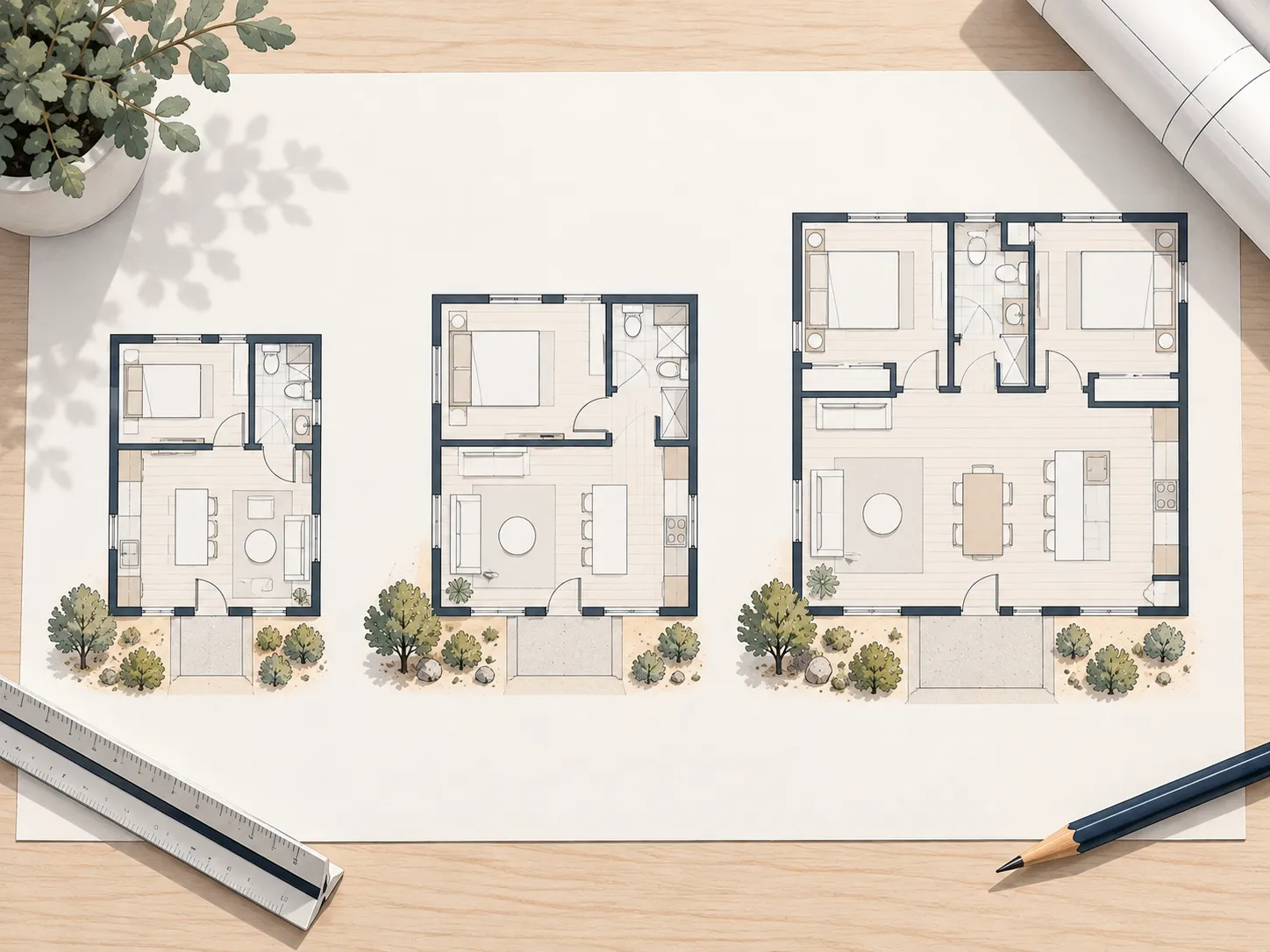
One caution: codes measure floor area their own way, and the county counts the full footprint of a one-story ADU minus specific exclusions like an attached garage, decks, and porch covers. Changes you make during plan design, such as enclosing a porch or extending a room, can push a plan over the limit. We check the code-measured area before a plan goes to permit.
Common reasons ADU plans stall
-
The lot is in a resource zone. EFU and forest land don’t qualify for a rural ADU, regardless of acreage.
-
The parcel is too small, especially in South County, where the minimum is five acres.
-
The site is more than 100 feet from the main house on a rural lot, often because the best view or the septic area is farther away.
-
Septic capacity. The existing system wasn’t sized for a second dwelling.
-
An existing guest house that has to be converted or retired first.
-
CC&Rs that restrict second units even where the city or county allows them.
-
Square footage creep during design that pushes past 800 or 900 square feet.
What to do next
-
Confirm jurisdiction and zoning in DIAL.
-
Rural lots: check acreage, confirm the parcel is in a rural residential zone, and measure where a 100-foot placement puts the ADU.
-
Check septic and water capacity for a second dwelling.
-
Read your CC&Rs.
-
Pick a plan that fits the size cap with room to spare for changes.
Browse our ADU plans on the floor plans page (filter by ADU), and if you’re still choosing land, start with our building lot checklist for Central Oregon.
How Select builds ADUs
We design and build ADUs with the same team and process we use for full-size homes, whether the ADU goes up alongside a new main house or on a lot you already live on. In a complimentary design consultation, we look at your lot’s zoning, placement options, septic and utility routes, and which plan fits, then carry it through permitting and construction as part of building on your land.
Thinking about an ADU? Request a complimentary design consultation or call 541.527.7462.
Frequently asked questions
How big can an ADU be in Bend? Inside Bend city limits, an ADU can be up to 800 square feet. If a lot has two ADUs, the second is limited to 500 square feet.
Can I build an ADU on rural land in Deschutes County? Possibly. The parcel has to be in a rural residential zone (RR-10, MUA-10, UAR-10, SR 2½, or WTZ), be at least two acres (five in parts of South County), already have a house, be served by a fire protection district, and meet septic and water requirements. Farm and forest zones don’t qualify.
How far from my house can a rural ADU be? No more than 100 feet from the primary dwelling.
Can I rent a rural ADU as a vacation rental? No. Rural ADUs in Deschutes County can’t be used for short-term vacation occupancy. Long-term use is a separate question; confirm any rental plans with the county before you build.
Do I need parking for an ADU in Bend? No minimum on-site parking is required for ADUs inside Bend city limits. New driveways and parking areas you do add must be paved and meet city standards.
This article is general information, not legal advice. ADU rules vary by lot and jurisdiction and change often, including with each legislative session. Confirm current requirements with the City of Bend, Deschutes County Community Development, or your local planning department before you design or buy.
OR CCB# 234456